 English
 Italian
A crucial moment of the ascent with climbing skins, the “Gucia”—as it is called in Cuneo dialect—or “kick turn” is the maneuver that allows the ski mountaineer to reverse the diagonal of progression on the slope.
Especially for beginners, it represents a crucial moment because you find yourself having to balance on one ski while lifting and rotating the other by almost 180 degrees. As if that weren’t enough, the Gucia often has to be performed on unstable snow because it’s powdery and deep, on icy or imprecise tracks, with obstacles uphill, or on steep terrain. It is therefore necessary to have good technique to avoid clumsy and potentially dangerous falls!
The following notes may be useful not only to novices but also to experienced ski mountaineers who, on several occasions, perform the maneuver in question with gross inaccuracies. In normal conditions, these can be managed successfully thanks to previous experience and a sort of “physical” balance, but in critical situations, better mastery of the movements could make all the difference.
First of all, it should be remembered that our legs are equipped with three joints (ankle, knee, hip) which, if used, allow for a wide range of motion. I used the phrase “if used” because I often notice that—in the worry of performing the turn quickly—people forget they have these joints and the skier’s movement becomes stiff. In this case, the change of diagonal is resolved with the famous “kick” which, while helping to move the tip of the rebellious ski, eclipses the technical base that allows us to finish the maneuver in stable balance.
And it is precisely balance that can prove to be the discriminating factor in delicate situations.
Here is a summary of the various steps necessary for the turn, in the hope of being able to illustrate in words how our body must shift to move the skis correctly.
Let’s begin.
We are climbing in a diagonal track and…
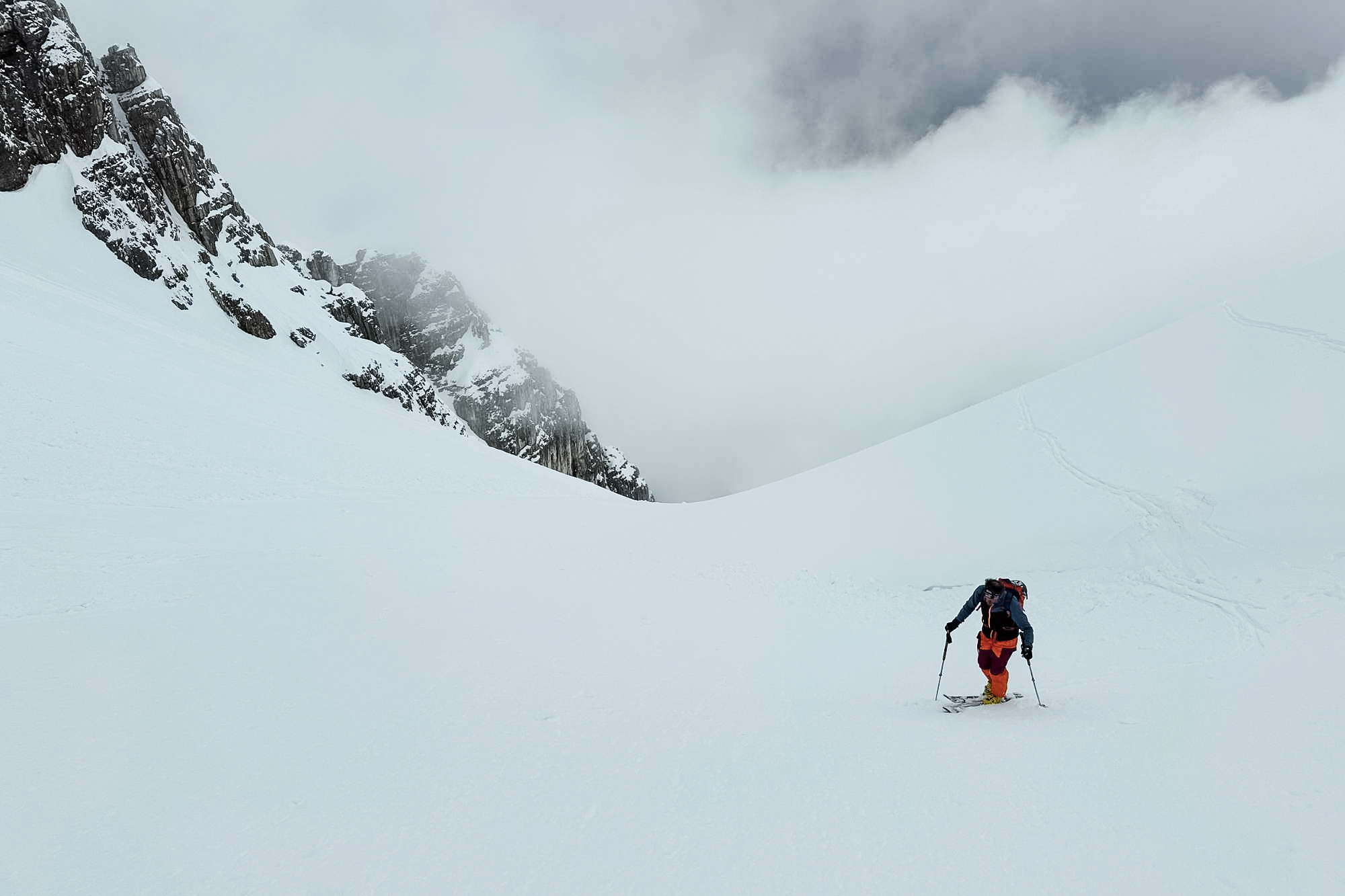
Salita in una traccia diagonale
1- At the end of the diagonal, you need to stop with the skis horizontal and parallel to each other, making sure they are stable on the slope whether in soft snow or on a hard snow track (in this second case, it is recommended to work the edge a bit to create a good supporting base).
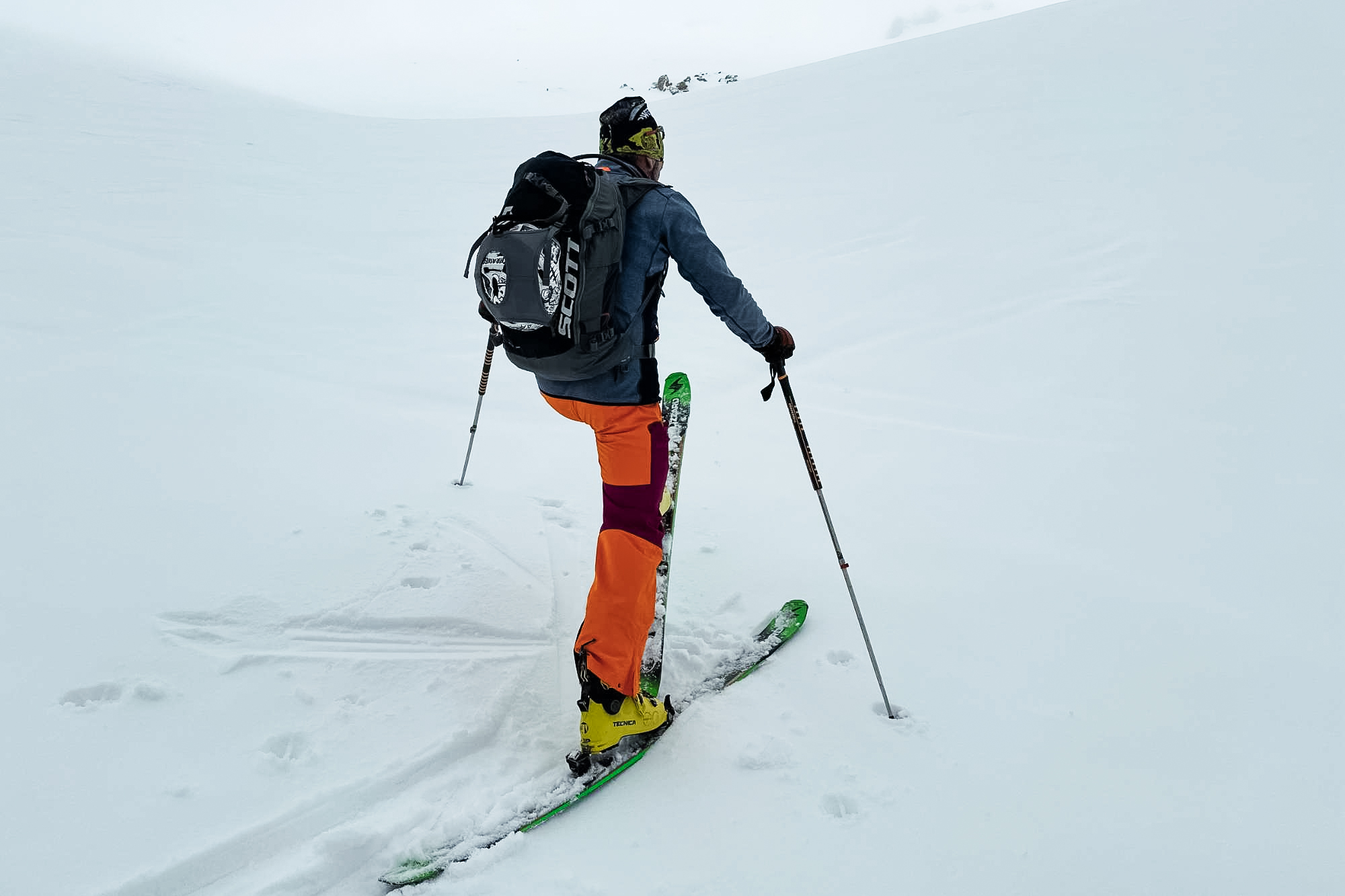
Fase 1 della Gucia
2- Rotate your torso uphill, positioning the uphill pole next to the tail of the uphill ski and the downhill hand pole next to the tip of the downhill ski.
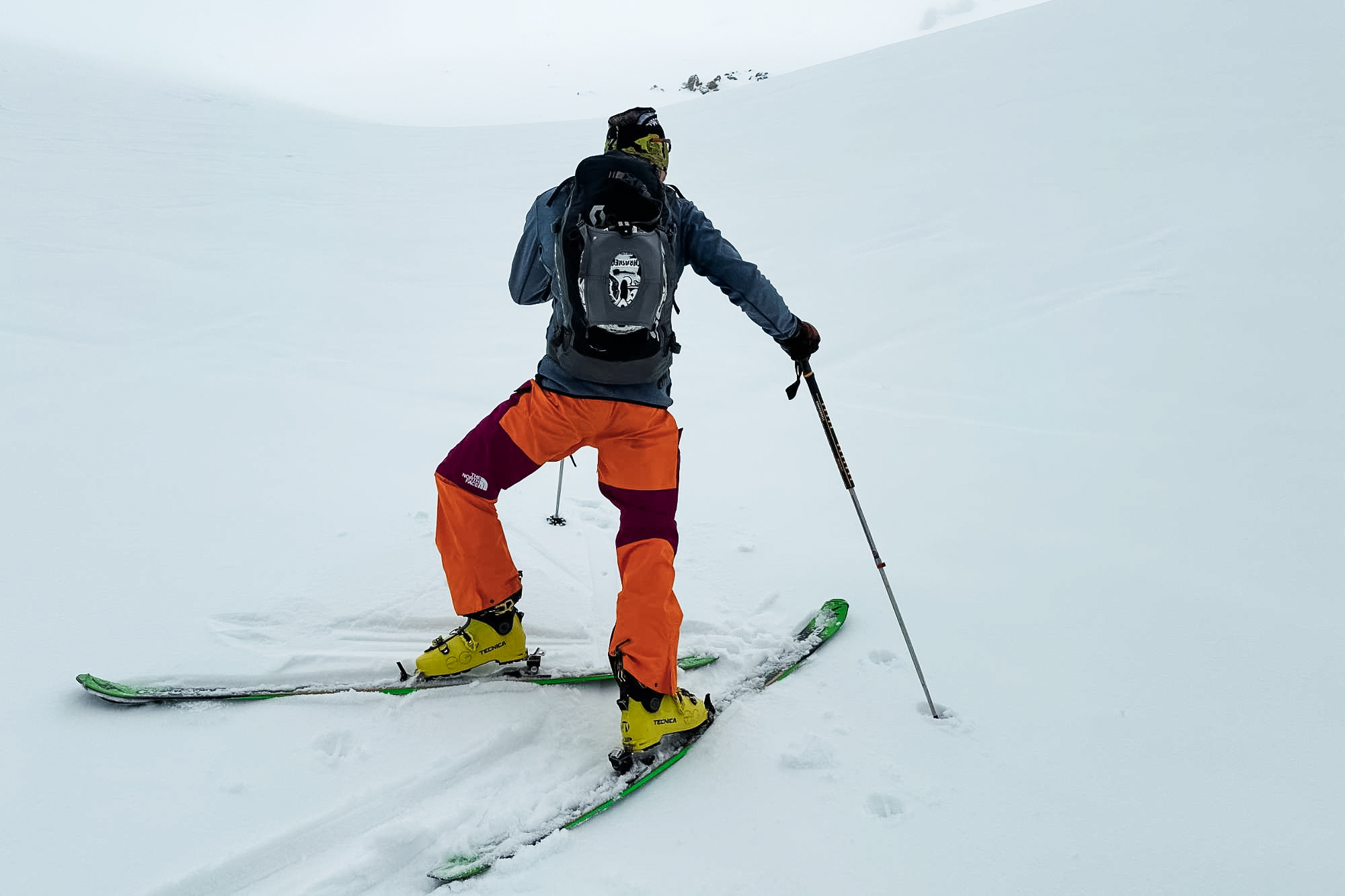
Fase 2 della Gucia
3- Rotate the uphill ski as close to 180 degrees as possible.
Attention! It is very important to imagine wanting to throw the ski high and far forward with the tip of your foot, and only then rotate the ankle and knee to let it fall back next to the other, thus finding the boots as close to each other as possible.
The most common mistake in this phase is not lifting the ski being rotated enough, practically pivoting with the tail of the ski next to the opposite foot and ending the movement with the two feet quite far apart. This will force a wide movement of the pelvis in the next phase, with the consequent risk of losing balance and subsequent “scrambling”…
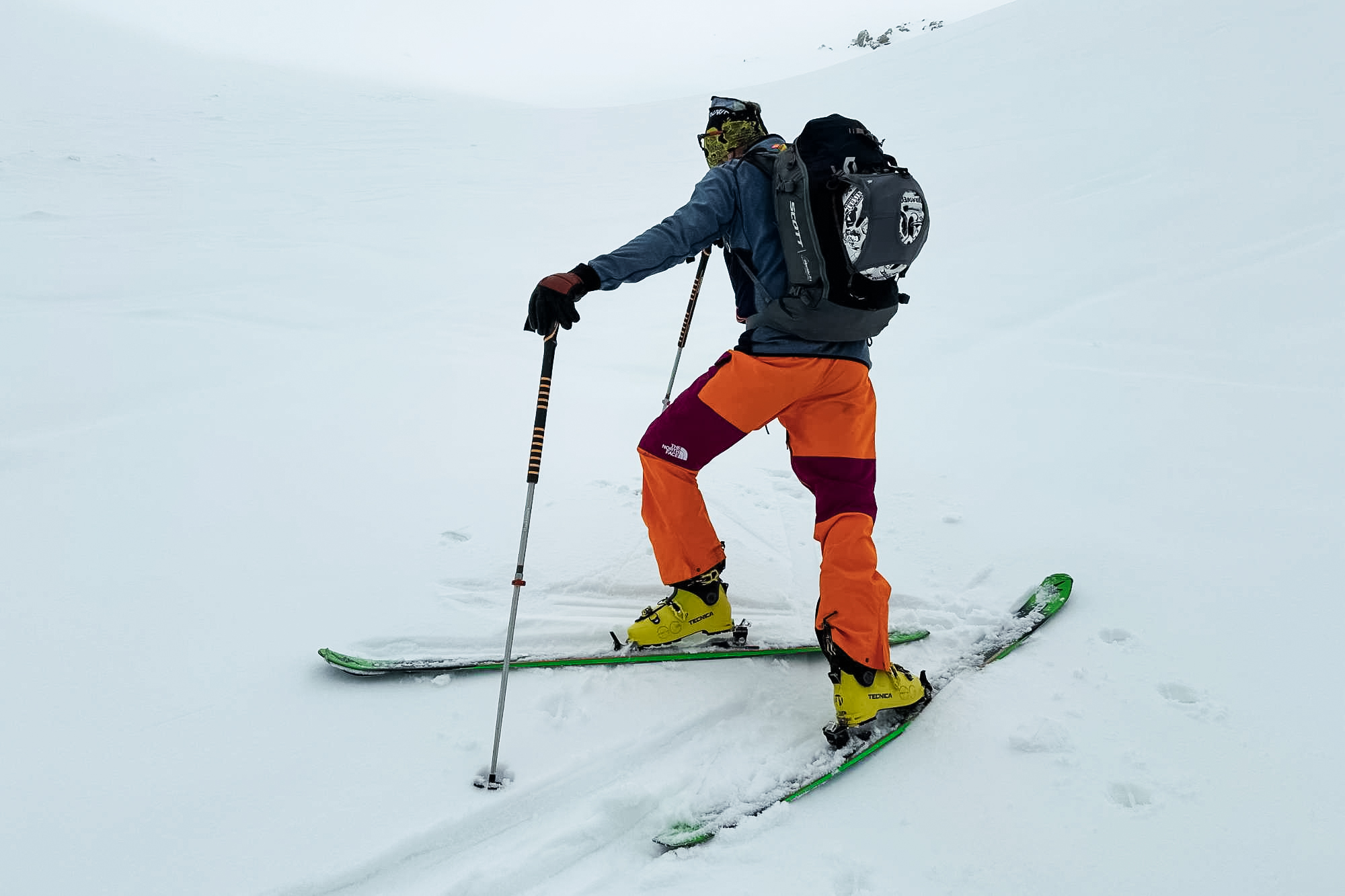
Fase 3 della Gucia
4- Rotate the torso further (which at this point will be almost in the direction of the next diagonal), moving the pole that was next to the tip of the stationary ski high up on the slope, planting it well so that it doesn’t inadvertently sink.

Fase 4 della Gucia
5- Shift your pelvis, rising in balance on the leg you just rotated.

Fase 5 della Gucia
6- Keeping the ankle absolutely relaxed and the inside edge of the ski close to the first rotated boot, bend the knee to lift the ski, open the hip to move it back to make room for the tip, and only then rotate it around the stationary leg to position it in the new diagonal.
Small ankle movements will help in this phase to move ski tips that might be buried in the snow and will ensure better fluidity.

Chiusura della Gucia
Note: In every phase, the torso should remain as upright as possible!
Adriano Ferrero
Guida Alpina dal ’98, da sempre appassionato di viaggi, sci e arrampicata, cavalli e grandi spazi, sport e natura. Dopo anni di viaggi nel mondo partorisce l’idea di Snowder® che, oltre ad un marchio, vuol essere un «modo» di viaggiare, dove la pratica di un’attività sportiva come lo scialpinismo diventa un’ottima «scusa» per mettersi in viaggio, un motivo per scoprire terre lontane – ancor meglio se poco frequentate – genti nuove, nevi e panorami sconosciuti.