 English
 Italian
Our Cycling Guide Erik Rolando will share all the secrets to tackling turns in the best way on your MTB. Before we dive in, let’s brush up on some basic concepts.
Centrality is the starting point for any technical work or maneuver. If needed, you can move forward, backward, stand up, crouch down, and/or move sideways to complete the movement.
If the starting point is a correct central position, small shifts are enough to achieve the right weight balance. Remember that you are in contact with the bike through 4 contact points (hands and feet).
While performing athletic maneuvers, you will always be standing up; accentuate the movement based on the difficulty of the action (e.g., a more or less complex turn).
The seated position is only used when pedaling or coasting on smooth surfaces. The trails we tackle on a bike, especially off-road, present various obstacles (holes, bumps, rocks, and turns).
Correctly executed technical maneuvers allow you to overcome various obstacles or situations safely and while having fun. Among these obstacles, we find the most common and hardest to interpret: the turn.
Depending on the ground conditions and the environment, it can be:
- simple or flat;
- bermed;
- off-camber;
- drifting;
By definition, it involves 4 fundamental phases, in which the weight balance is more or less accentuated.
A turn is executed correctly when the transition between phases is smooth; it should be set up ahead of the natural line of the trail (in jargon, this is called “anticipating the turn”).
This is because it prevents you from falling behind between turns and, consequently, having lines that would force you to slow down.
What are these 4 phases?
We list them below:
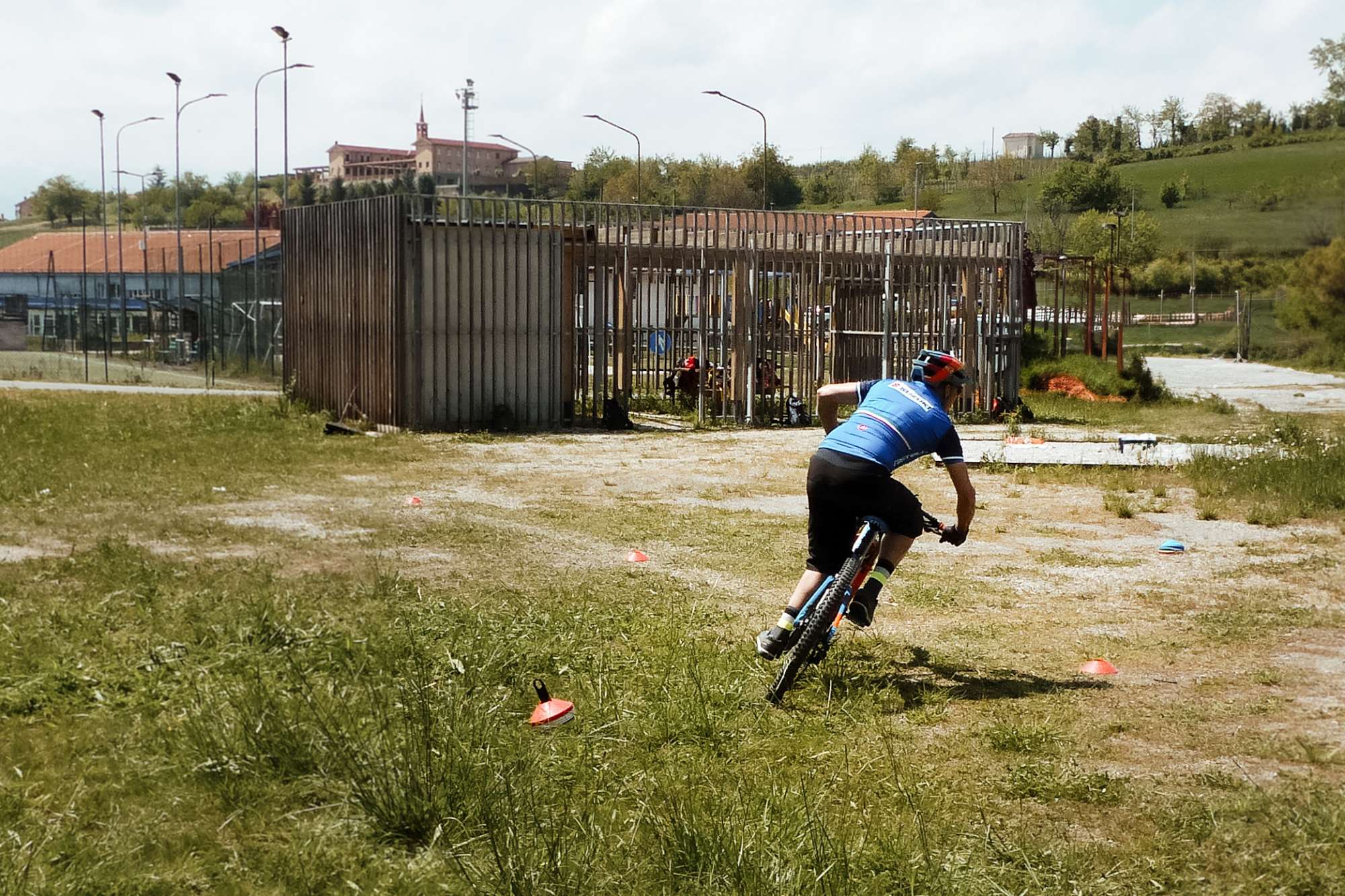
- Anticipation: the correct line is chosen and speed is adjusted.

Fase 1 – Anticipo
- Entry: the bike’s angle changes and the weight balance toward the outside is increased.
Fase 2 – Inserimento in curva
- Apex: this is the central phase of the turn, where weight compensation is at its peak with the load toward the outside.

Fase 3 (inizio) – Aumento pressione sulle spalle dei copertoni

Fase 3 (parte di conduzione) – Massima pressione dei pesi
- Exit: weights return to the starting position, preparing for the acceleration or the next turn. In a sequence, the exit often coincides with the anticipation.

Fase 4 – Alleggerimento pressione e preparazione per uscita di curva
Assuming that centrality is the foundation, it follows that the rider has 4 contact points (the saddle is not considered a contact point because it would be a constraint when performing technical maneuvers where maximum freedom of movement and trail interpretation are required).
It’s important for the center of gravity to fall within the “central projection area” to maintain a balanced position. Off-roading pushes technical maneuvers and weight shifts to the extreme in the search for balance because grip is generally lower.
Your gaze, shoulders, and pelvis must be in the direction of the exit line to allow for correct weight distribution and facilitate the bike’s turn,
A slightly flexed inner elbow ensures the correct execution of the maneuver and partially “counterbalances” the pressure exerted by the outer foot, which is down with the heel toward the ground.
Errors: A straight inner arm inevitably causes the shoulders to rotate in the opposite direction of the desired one. An open outer knee inevitably causes the pelvis to rotate in the opposite direction of the desired one.
In addition to Centrifugal and Weight forces, the forces at the point of contact with the ground must also be considered in the dynamics of a turn. The greater the grip (for example, a road or gravel bike on smooth, intact asphalt), the less impact you’ll need to have when shifting forces. This is the typical case of a cyclist on paved ground who manages to take a turn in a seated position. This happens because the speed isn’t high and the grip on the ground is sufficient to maintain balance.
The question to ask is: at what speed could the same turn be taken, under the same conditions, but with better weight balance?
If you enjoyed the article, I’ll see you in the next newsletter. I would like to thank Davide Michelis for his valuable contributions.
Feel like going for a ride? Then take a look at our offers.
Basic mechanics course: extraordinary maintenance
Basic mechanics course: routine maintenance
Entry Level Course, 1-day course
Basic Course: ready single track, 3-day course
La Thuile Bike Park with a scenic pedaled tour at the foot of Mont Blanc
La Thuile World Cup, bike park and tour
The Barolo Sanremo bike: the trip you don’t expect!
La Thuile MTB: panoramic ride at the foot of Mont Blanc
Among the peaks of Anatolia and Cappadocia: an adventure between nature and tradition
Erik Rolando
Guida ciclosportiva nazionale e regionale dai primi anni 2000, istruttore Nazionale della Federazione Ciclistica Italiana, docente ai corsi da Guida Cicloturistica in regione Piemonte e Valle d’Aosta, da sempre in bicicletta e grande appassionato di montagna, mountain bike e cicloviaggi. Ha scritto alcune guide di percorsi in MTB e cicloturismo seguendo come filosofia di vita il connubio sport e natura. Dopo anni di cicloviaggi nel mondo e corsi di tecnica di guida e cultura della bicicletta a 360° ha deciso di progettare esperienze per i viaggiatori a pedali e per chi vuole migliorarsi in bicicletta con l’obiettivo di coniugare le pedalate in bikepacking o i single track con la convivialità di un rifugio e il buon umore aggiunto dalla cucina e folklore locali.