 English
 Italian
The Urner Haute Route is also known as The Skier’s Route, and it is an unforgettable adventure, especially for those seeking the essence of ski touring far from the groomed slopes. In five days, starting from Andermatt (the junction of the roads leading to the Alpine passes of St. Gotthard, Furka, and Oberalp) in the Canton of Uri, you reach Engelberg, a resort town in the Canton of Obwalden.
Known for its heavy snowfall, this itinerary in the heart of the Swiss Alps offers long descents on north-facing slopes and ideal gradients, crossing glaciers and ever-changing landscapes.
Mountain guide Adriano Ferrero presents the report and some images of this 2026 ski touring trip, carried out with a group of clients he accompanied.
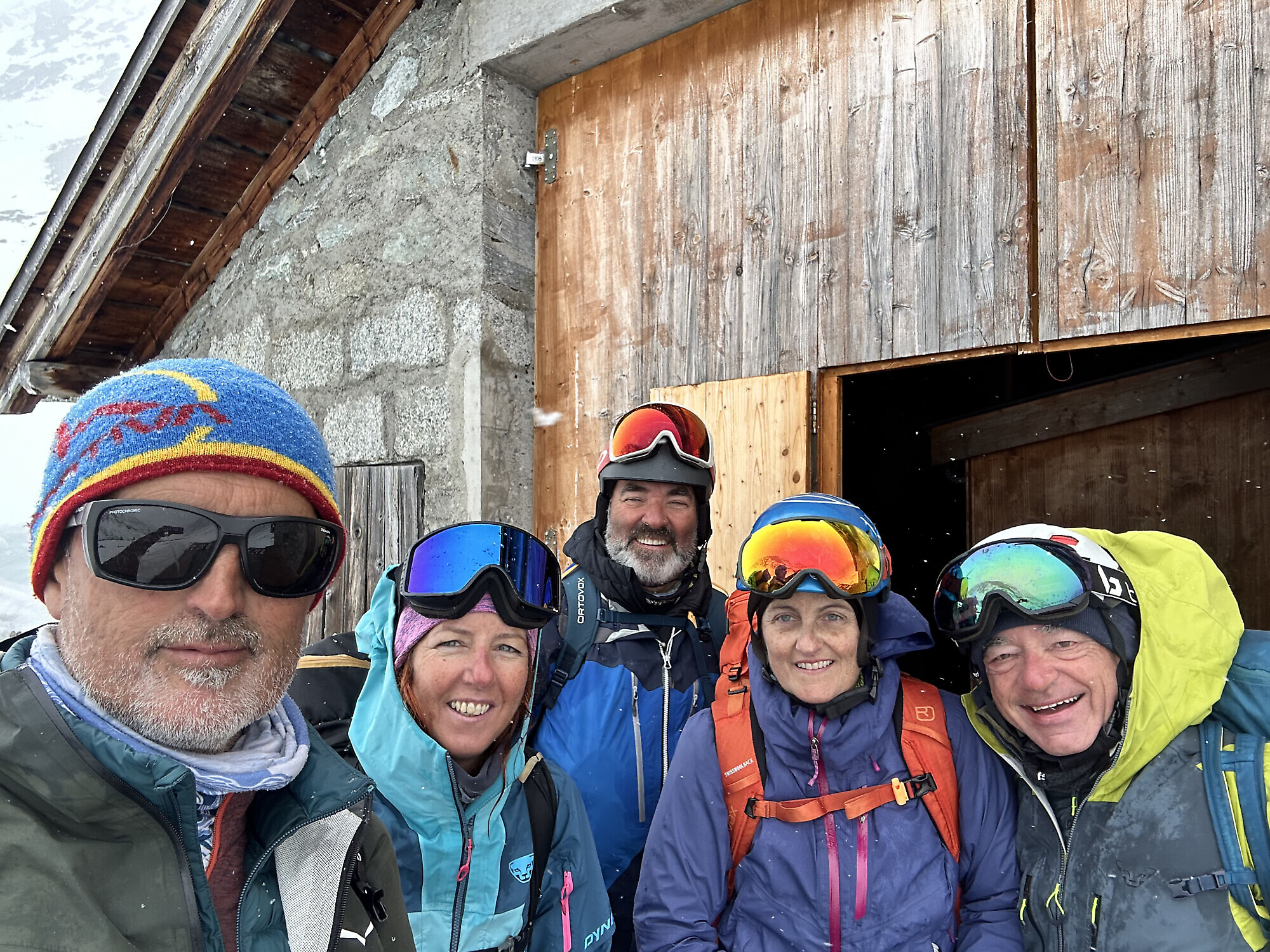
Everything according to plan… until the storm arrived
The ski touring traverse, starting from the village of Realp, located a few kilometers upstream from Andermatt, ends in Engelberg. These are two quite famous ski resorts: the former primarily for freeride skiing, the latter for piste skiing.
The itinerary crosses the Canton of Uri, in the heart of Alpine Switzerland, passing through a series of valleys that offer remarkable geological variety – and when the geology changes, the morphology of the mountains changes too, and consequently the environment as well. So, from granite rocks and landscapes reminiscent of Fitz Roy in Patagonia, you reach the Sustenhorn area (3,503 m), with gneiss mountains exceeding 3,600 meters surrounded by glaciers whose morphology recalls the Western Alps; after which the final part of the ski tour changes scenery again from a geological point of view, as you enter an area of limestone rocks with steep slopes and many couloirs.
But let’s get to the traverse. On the first day, we start from Realp and, climbing for a short stretch along the road leading to the Furka Pass, we reach the Albert-Heim-Hütte (2,542 m), a beautiful modern hut, perfectly managed, where it’s really comfortable. When we arrived, after first crossing a peak that wasn’t too high, the weather had started to turn bad. So we relaxed all afternoon and spent the evening at the table enjoying an excellent dinner.
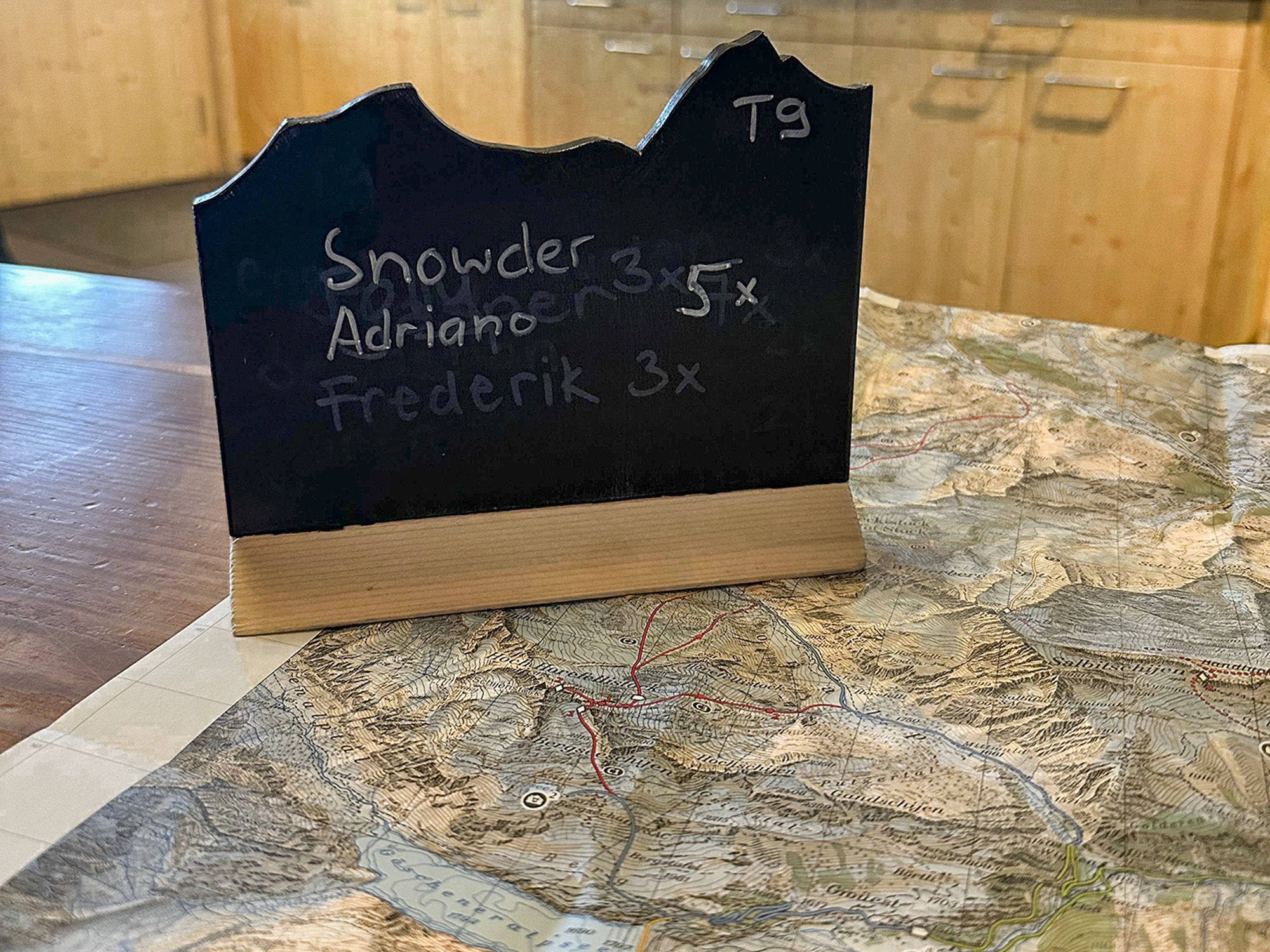
The next morning, when we woke up, it was snowing, but the forecast predicted improving weather. So we set off from the hut, facing a fairly easy first descent; then, having reached a col, we put on our crampons, shouldered our skis, and climbed a snowy couloir to reach the summit of Lochberg (3,079 m), followed by a long ski down to Göscheneralpsee, a reservoir built in 1960 and used by the Göschenen power station.
From here, with one last climb, partly slightly technical, you reach a small old-style hut for mountaineers who don’t care too much about comfort, run by two very kind and “efficient” girls: the Chelenalphütte (2,350 m).
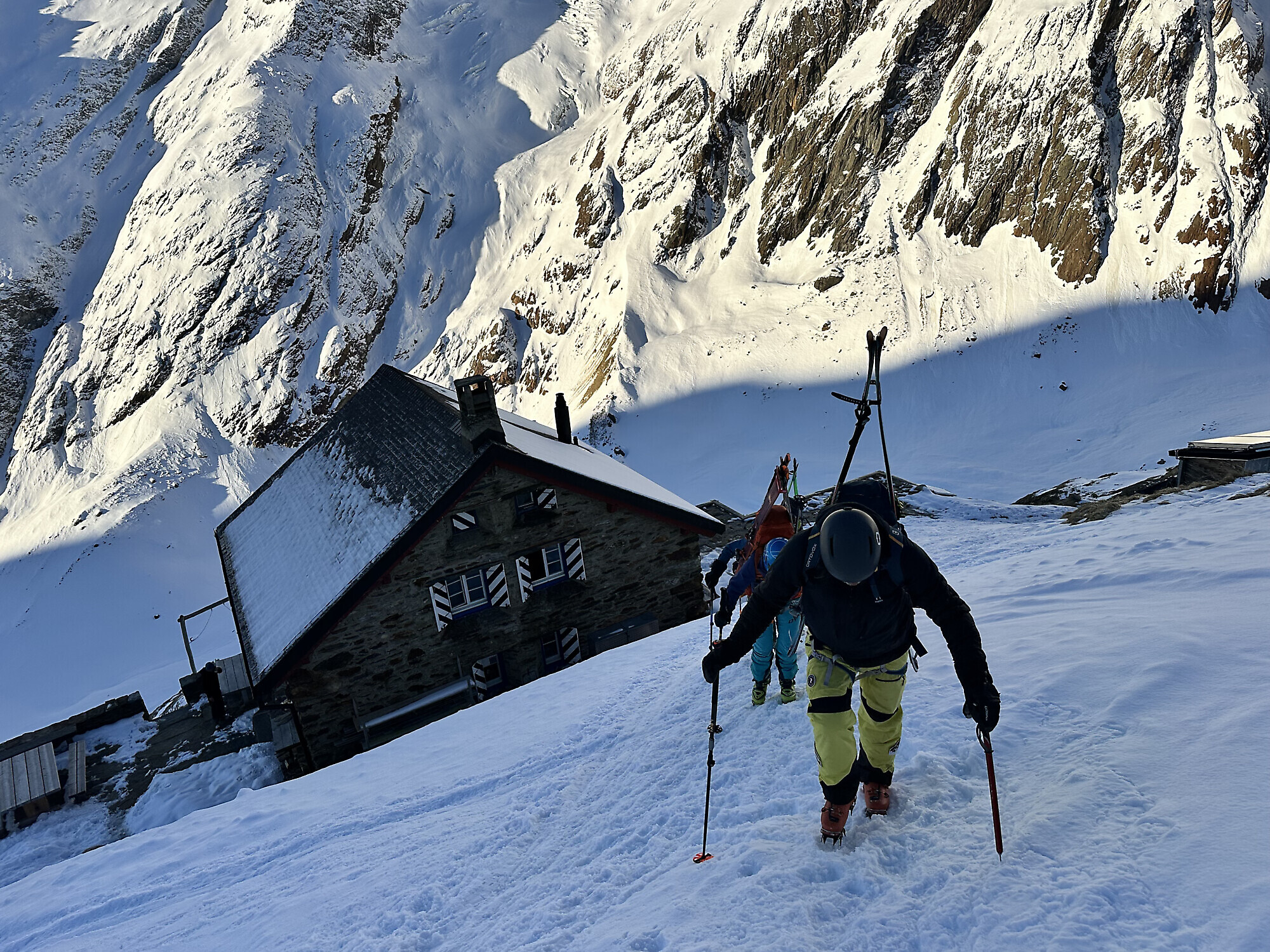
On the third day, we immediately face a technical section: with crampons on and ice axe in hand right from the hut, we climb a very steep initial stretch in a sort of couloir, then continue more gently to the Sustenlimi, a saddle after which we proceed uphill on the glacier to reach the “summit” of the entire tour, the Sustenhorn. From here, there is a very long ski down the Steingletscher to reach the Berghotel Steingletscher, at about 1,860 meters above sea level, after enjoying a 1,500-meter vertical descent, first on the glacier, then on the moraine, always on powder snow.
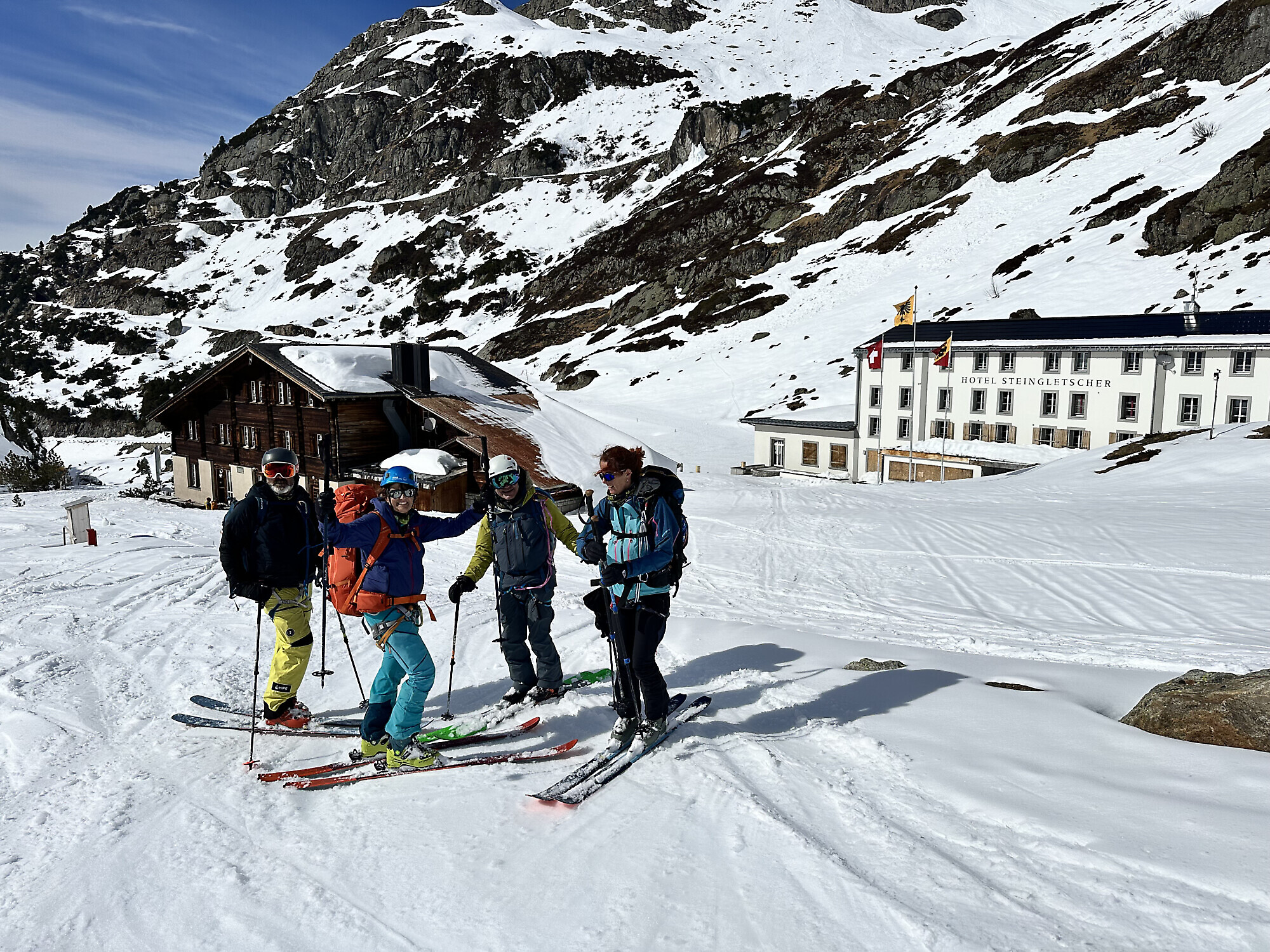
Our trip included two more days of traversing, but the arrival of a strong storm forced us to give up. Therefore, on the morning of the fourth day, instead of climbing the Fünffingerstöck, we had to climb about 300 meters in the middle of the blizzard, cross the Susten Pass, a road pass that is open to car traffic in summer, and descend into the valley on the opposite side, where after a long ski and then by hitchhiking we arrived in Wassen, a village a few kilometers from Andermatt.
From here we took a taxi to reach Engelberg and then returned to Italy by minibus.

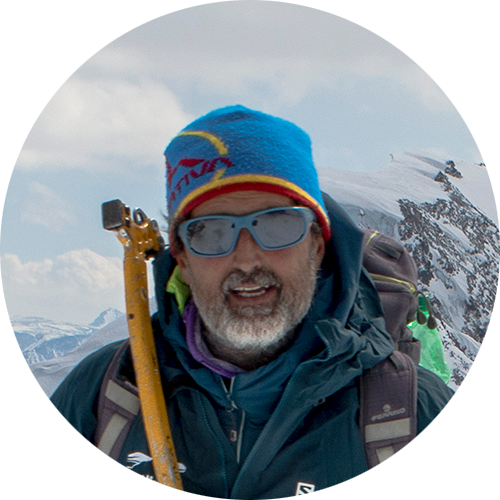
Adriano Ferrero
Guida Alpina dal ’98, da sempre appassionato di viaggi, sci e arrampicata, cavalli e grandi spazi, sport e natura. Dopo anni di viaggi nel mondo partorisce l’idea di Snowder® che, oltre ad un marchio, vuol essere un «modo» di viaggiare, dove la pratica di un’attività sportiva come lo scialpinismo diventa un’ottima «scusa» per mettersi in viaggio, un motivo per scoprire terre lontane – ancor meglio se poco frequentate – genti nuove, nevi e panorami sconosciuti.